Goals & Deliverables
Guide to Grant Applications
Goals and Deliverables (formerly known as Outcomes and Outputs) is one of the most important sections to complete in Atlas Network's grant applications. It communicates (1) the impact you aim to achieve and (2) the actions you will take to get there. Think of it as a simplified version of your Theory of Change—your roadmap to impact, so you don't get lost along the way.
In this section, we prompt our grant applicants to select measurable and meaningful goals that encourage continuous evaluation and learning. The metrics included should guide decision making, indicating that you are making progress in the right direction to reach your long-term vision of success.
Step-by-Step
Guide
A simple framework to tackle Atlas Network's Goals and Deliverables.
Long-term, ambitious goals that help an organization focus energy and resources and track meaningful progress toward the mission.
The changes or impacts you hope to achieve that demonstrate progress toward your North Star.
The tangible products that contribute to achieving the project goals.
Quantitative milestones that help measure progress toward your project goals.
The methods/tools used to confirm indicators are met. Describes how the data will be collected.
1. Begin with the end in mind
Before selecting which projects to pursue, begin by reflecting on your organization's mission, model, and North Stars. The projects you carry out should be a response to the question "How do we move toward achieving a particular organizational North Star and our mission?" While your organization should have more than one North Star, individual projects help move the organization toward achieving one or a few North Star(s).
North Star = The long-term goal
The big, ambitious change your organization is working toward over time.
Consider:
- What would a big win for your team look like?
- What are you hoping for in the long run (3-5 years)?
- What is a big, ambitious goal that scares you a little bit?
Examples of North Stars:
- Our evidence and storytelling will persuade influential stakeholders and decisionmakers that price controls are harmful, and resulting reforms will ensure key consumer goods are readily available.
- We will earn the trust of a growing and diverse set of funders.
With your mission, model, and at least one of your organizational North Stars in mind, you can identify what your organization would have to achieve in the shorter term to move towards achievement of the chosen North Star(s). This is where project development begins. Once that is clear, resist the temptation to jump straight to activities. Instead, ensure you have a clear Project Vision Statement before defining how the work will be carried out.
Project Vision Statement: Defines what success looks like for your proposed initiative or project. It articulates what you will see change if your project plans are wildly successful; it is aspirational, motivating, and aligned with your organization's North Stars. What completed project or achievement would make you pop champagne to celebrate?
Examples:
- Empower policymakers to eliminate restrictive price controls, ensuring a freer market where key consumer goods remain accessible to all.
- Foster a new generation of students who understand the principles of individual liberty and limited government, equipping them to advocate for a freer society.
2. Connect the key elements
Review your Organizational North Stars → Identify your Project Vision Statement → Identify Goals → Plan Deliverables
Consider what conditions must be met to make meaningful progress toward these organizational North Stars and Project Vision Statement. From there, determine the desired market response that would indicate success. (These are your goals.)
Goals = What changes because of your work
The real-world difference you want to see (behavior, policy, awareness, etc.).
Examples:
- The adoption of policy reforms that result in a reduction in the typical number of days and costs to obtain a business permit, lowering barriers to entry and encouraging businesses to enter the formal economy.
- Foster a deeper understanding of the principles of individual liberty and limited government among high school students.
Indicators = How you know the change is happening
The specific, measurable signs that show progress toward your goal.
Quantitative milestones that help measure progress toward your goals. What milestones will we include and work toward to know we are making progress in achieving our goal? You may have more than one indicator for each goal, but it's a good idea to keep the total number of indicators manageable and meaningful.
Examples:
- At least five policymakers publicly endorse the recommended policy reforms and two political parties adopt them as part of their agenda.
- A 20% increase in students who can accurately articulate classical liberal principles and their practical applications.
Effective goal indicators are often guided by the SMART framework. SMART goals are a helpful tool, but you should use the SMART guidelines as a flexible framework. Ensure that you utilize this guide in a manner that is most helpful to the unique needs of your organization.
- Specific: Make your goal specific and narrow for more effective planning.
- Measurable: Make sure your goal and progress are measurable.
- Achievable: Make sure you can reasonably accomplish your goal within a certain time frame.
- Relevant: Your goal should align with your values and long-term objectives.
- Time-based: Set a realistic but ambitious end date to clarify task prioritization and increase motivation.
Evidence = Where the data comes from
The data source or method you'll use to track progress.
Examples:
- Monitoring legislative voting records and government publications confirming policy adoption.
- Tracking video view data from social media platforms as well as the number of new email subscribers.
Finally, identify the specific actions and initiatives required to generate that response and move closer to realizing your Project Goals (these are your Deliverables).
Deliverables = What you create or do
The activities, products, or outputs you control.
Examples:
- One research paper on the economic benefits of simplifying business permit requirements. One policy brief. A corresponding education campaign.
- Two summer camps focused on classical liberalism. One book discussion at three different universities. Distribution of 100 books to students.
Here is one way to think about goals vs. deliverables: deliverables are controlled by you, while goals are market responses that reflect how stakeholders respond to your work.
3. Monitor & Evaluate
Goals may evolve over time—especially if a particular indicator proves unhelpful in informing decisions or accurately measuring progress. In such cases, adapting and refining goals is not only acceptable but encouraged, as it leads to more meaningful insights.
Once your initiative is funded and underway, consistently monitor and evaluate your progress toward the specified goals and deliverables. It is reasonable to expect that, along the way, you could determine that the goals set at the beginning may not be the useful measures of success you expected them to be. Be prepared to adapt your approach as needed to stay on track toward your main goal and vision of success.
4. Examples of Goals & Deliverables
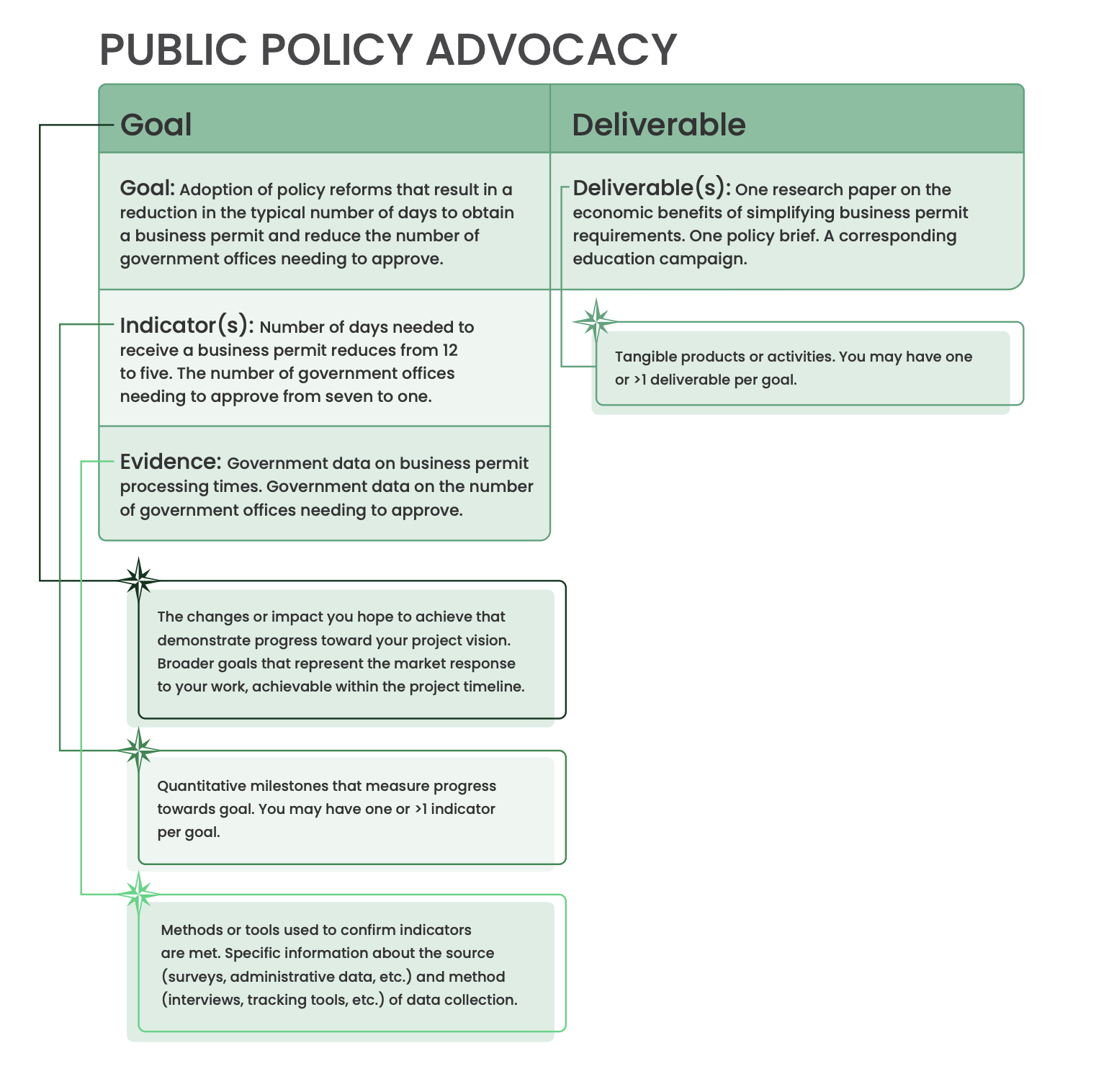
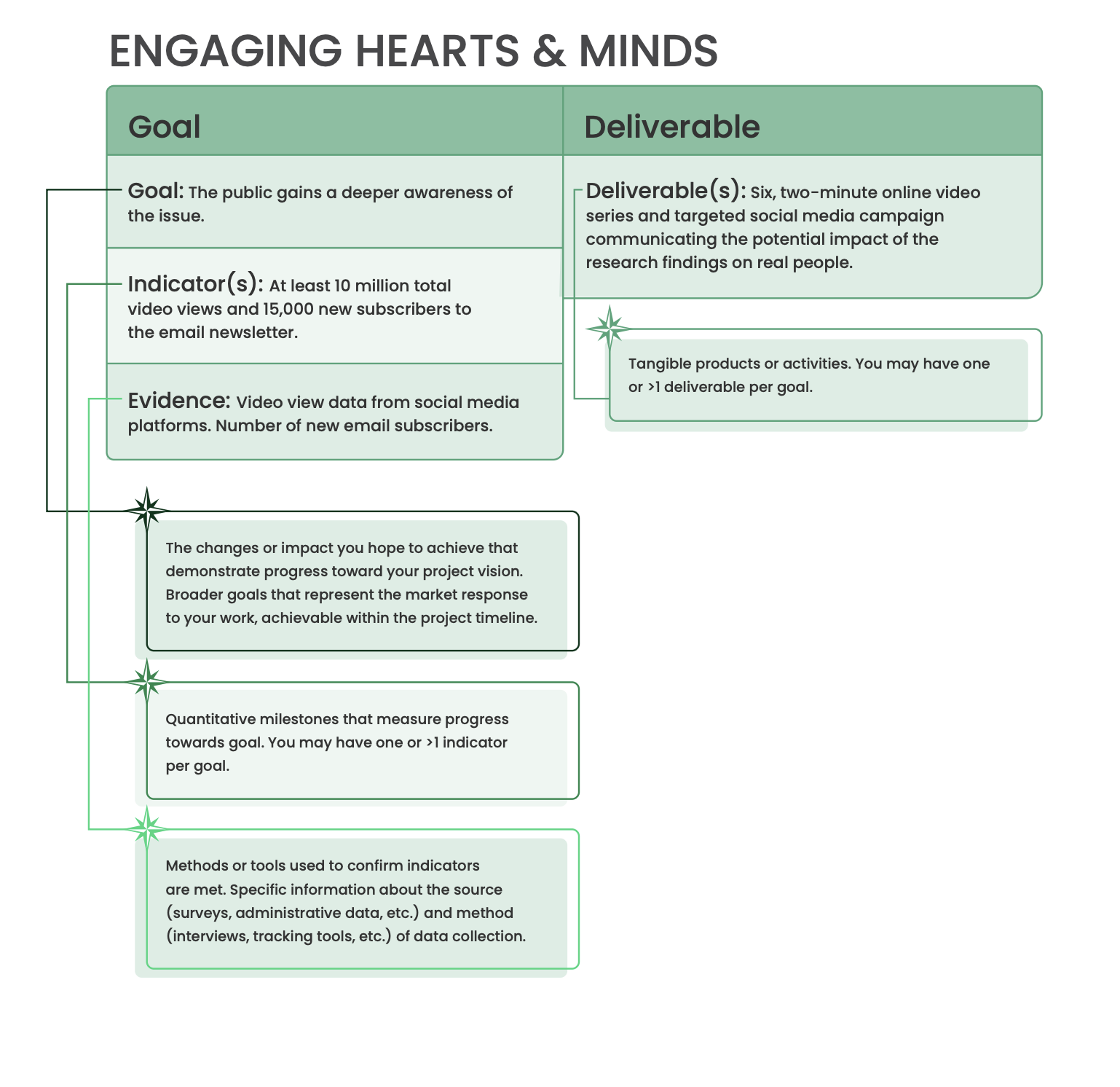
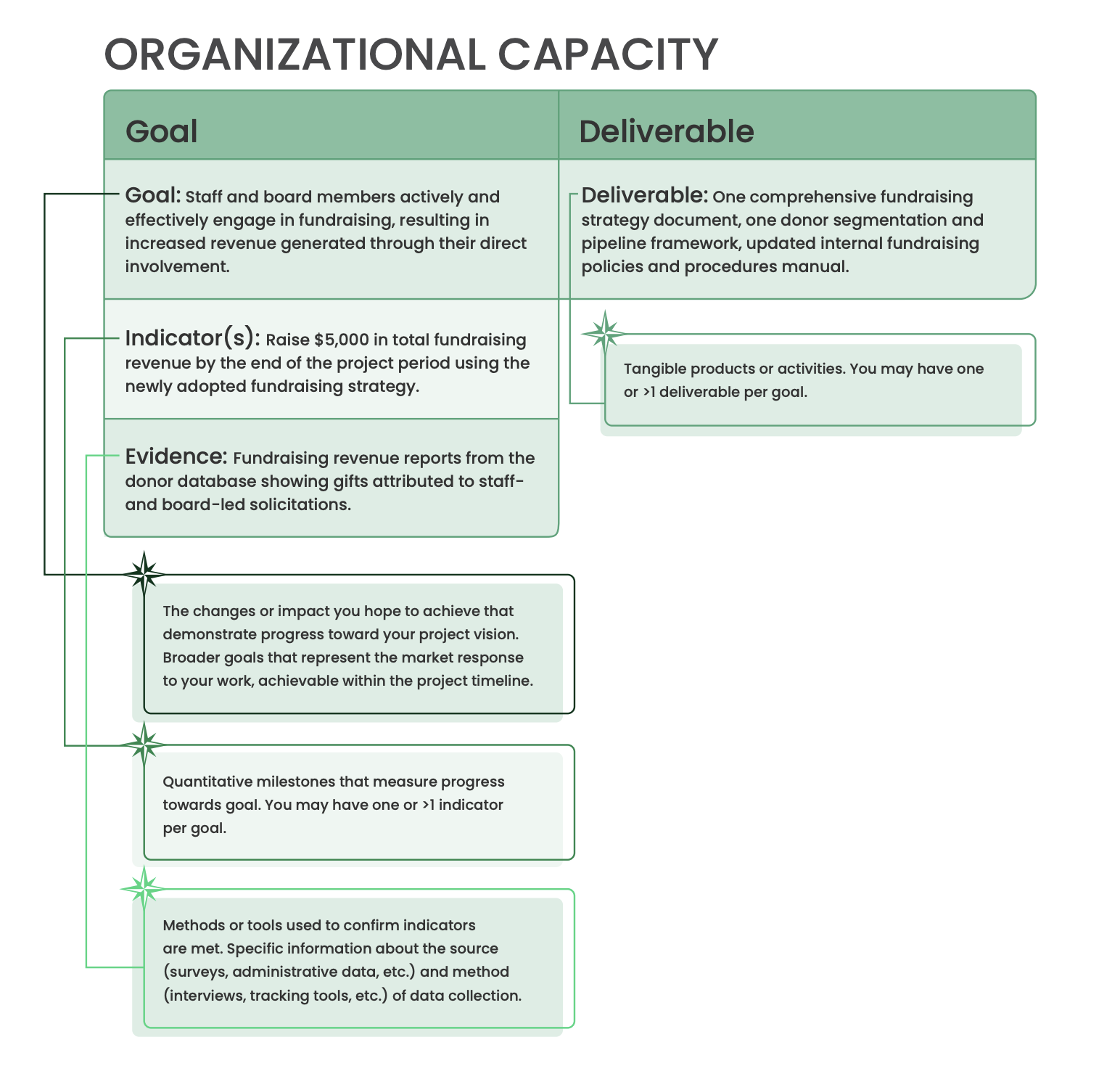
5. Use AI to refine & stress-test
Your Goals should come from you and your team — not from a chatbot. The most meaningful goals reflect the real change you're working toward, and they come out of your own thinking and honest conversations with your team about the impact you hope to achieve. Draft them yourselves first. Once you have a working set of Goals, Indicators, Evidence, and Deliverables, AI can be a useful second set of eyes — to refine your wording, stress-test your logic, and surface additional directions you may have missed.
Do not rely on AI to come up with your goals for you. The prompt below is built to work only after you've done the thinking: it asks you to paste in your own drafted goals, and it will push back if you show up empty-handed. Use it to pressure-test what you've already built — not as a shortcut around the work.
And take its feedback with a grain of salt. AI sounds confident even when it's wrong. It will happily invent plausible numbers, cite evidence sources that don't exist, and miss the regional and organizational context that makes your work real — because it doesn't know your project the way you do. Treat every suggestion as a prompt to think harder, not an instruction to follow: keep what genuinely sharpens your goals, and discard the rest.
How to use it: first, draft your Goals with your team using the framework above. Then copy the prompt below, paste it into your preferred AI tool, and paste in your own drafted Goals (with any Indicators, Evidence, and Deliverables) where the prompt asks for them. Attach your project document too, if you have one, for extra context. The AI will review what you wrote, suggest refinements, stress-test your logic, and flag gaps — it won't hand you a finished section.
Your project details, strategy, and any documents you share are sensitive. Before pasting them into any AI tool, use a model and account configured so your inputs are not used to train the model and are not retained beyond your session.
- ChatGPT: turn off "Improve the model for everyone" in Data Controls, or start a Temporary Chat (the incognito-style mode that won't appear in history, isn't used for training, and is deleted after 30 days). Team/Enterprise workspaces have training off by default.
- Claude: consumer chats are not used for training by default; Claude for Work / API never trains on your data. You can also start a fresh chat and delete it from your history when finished.
- Gemini: turn off "Gemini Apps Activity," or use the Incognito-style temporary chat (no history, not used for training). Google Workspace Enterprise data is not used for training.
- Grok: turn off data sharing in Settings → Data Controls, or use Private Chat mode — conversations skip your history and are not used for training.
When in doubt, use the tool's incognito / temporary chat mode and double-check privacy settings before you paste — and avoid including donor names, partner details, or anything you wouldn't want stored externally.
You are an expert grant-writing coach helping me strengthen the Goals and Deliverables section of an Atlas Network grant application. I have already drafted my own Goals with my team. Your job is NOT to write goals for me — it is to stress-test them, refine my wording, and (only where genuinely warranted) suggest additional goal directions I may have missed, all grounded in the goals and project I give you.

HARD REQUIREMENT: I must supply my own drafted Goals in the "MY DRAFTED GOALS" block near the end of this message. If that block is empty, or contains only a project description with no actual goals, do NOT invent goals for me. Instead, stop, tell me to workshop my goals with my team first, and offer 3 short questions to help us get started. Do not produce a finished set of Goals from scratch under any circumstances.

## Framework

Atlas Network's Goals and Deliverables framework has four elements:

- Goal — Describes what *others* do in response to your work: the real-world change you want to see (policy adopted, awareness shifted, behavior changed). Goals are market responses outside your direct control.
- Indicator — A specific, measurable, numerical milestone that signals progress toward a Goal.
- Evidence — The data source and collection method used to confirm the Indicator (government records, surveys, dashboards, voting data, analytics, etc.).
- Deliverable — A tangible product or activity you produce and control (research paper, video series, training session, policy brief).

Relationships: Indicators measure progress toward Goals. Evidence proves an Indicator was met. Deliverables are what you do to make the Goal more likely.

## Structural rules (hard caps enforced by the application)

- 1 to 5 Goals per application.
- 1 to 5 Indicators per Goal.
- 1 to 9 Deliverables per Goal.
- Every Indicator has its own Evidence (1:1 — they pair on the application form).
- Every Deliverable belongs to exactly one Goal.

Most strong proposals have 1-3 Goals. More Goals make tracking harder. Return the smallest number that genuinely fits the project — 2 strong Goals beats 5 mediocre ones.

## Word limits

The application enforces hard caps. Language models are unreliable at counting words, so aim ~15% under each cap as a buffer. The in-app counter is the source of truth; I will verify before submitting.

- Goal statement: target ~60 words (75 hard cap).
- Indicator statement: target ~50 words (60 hard cap).
- Evidence: target ~60 words (75 hard cap).
- Deliverable statement: target ~60 words (75 hard cap).

## Quality criteria

Goals can be qualitative. They describe a desired change in the world — they do not need to include numbers.

Only Indicators must be numerical. Apply SMART to Indicators specifically:
- Specific — narrow and concrete.
- Measurable — every Indicator includes a number (count, %, $, days, etc.).
- Achievable — realistic within the project timeline.
- Relevant — aligned with the project's mission and funding topic.
- Time-based — has an end date, duration, or cadence.

Evidence must name a specific source AND collection method (never "we will track this").

Deliverables must be tangible things you produce (a paper, a campaign, a workshop) — never the change you hope to cause.

## Good vs. bad phrasing

Goal (market response):
  GOOD: "Adoption of policy reforms that reduce business permit processing from 12 days to 5 days."
  BAD:  "Publish a policy brief on permit reform." (← Deliverable, not Goal.)

Indicator (quantified milestone):
  GOOD: "At least 5 policymakers publicly endorse the recommended reforms; 2 political parties adopt them in their platforms."
  BAD:  "Increased policymaker engagement." (← not measurable.)

Evidence (data source + method):
  GOOD: "Government permit-processing records pulled quarterly; media-monitoring tool flags policymaker endorsements."
  BAD:  "We will track this somehow." (← no source named.)

Deliverable (tangible activity):
  GOOD: "One 20-page research paper on permit reform; one 4-page policy brief; a targeted social-media campaign reaching ~50,000 impressions."
  BAD:  "Public awareness rises." (← Goal, not Deliverable.)

## Complete worked example

For a project on simplifying business permits in Country X:

## Goal 1
**Statement:** Adoption of policy reforms that result in a measurable reduction in the typical number of days and cost to obtain a business permit, lowering barriers to entry and encouraging businesses to enter the formal economy.

**Indicator 1:** Number of days needed to receive a business permit reduces from 12 to 5 within 18 months of reform passage.
**Evidence 1:** Government records on business-permit processing times, pulled quarterly from the Ministry of Trade's public registry and compared against a 2024 baseline.

**Indicator 2:** Number of government offices required to approve a permit drops from 7 to 1 within the same window.
**Evidence 2:** Government administrative-procedure documentation, reviewed annually and benchmarked against the 2024 process map.

**Deliverable 1:** One research paper on the economic benefits of simplifying business-permit requirements, distributed to parliamentary committees.
**Deliverable 2:** One 4-page policy brief targeting parliamentary committee members and ministry staff.
**Deliverable 3:** A corresponding education campaign reaching ~30 stakeholder organizations through three regional roundtables.

## How to respond

### Step 0 — Confirm I brought my own goals

Check the "MY DRAFTED GOALS" block below. If it has no real goals in it (it's empty, or holds only a project description), STOP here. Tell me to draft my goals with my team first, give me 3 short questions to help us get started, and do not continue. Do not draft goals for me.

### Step 1 — Stress-test each goal I gave you

Wrap this pass in <thinking> ... </thinking> tags. For each Goal I provided, check:
- Is it a market response (a real Goal), or a Deliverable in disguise?
- Does each Indicator include an actual number and a time element?
- Does each Evidence entry name a specific source AND a collection method?
- Is each Deliverable a tangible thing I produce?

Name the weakest link in each goal. Keep this block under ~200 words. If your client strips <thinking> tags, replace them with the heading `### Analysis (internal)` and a `---` divider before Step 2.

### Step 2 — Refine, don't replace

For each Goal, Indicator, Evidence source, and Deliverable I wrote, offer a tightened version within the word caps above. Preserve my intent, my numbers, and my voice. Do NOT invent numbers, evidence sources, dates, or facts I didn't give you — if something essential is missing, flag it as `[you need to supply this]` rather than filling it in yourself.

### Step 3 — Suggest additional directions (only if warranted)

If — and only if — my project clearly supports an important Goal I haven't captured, propose up to 2 additional candidate Goal directions. Label them clearly under a `## Suggestions to consider` heading, and keep them grounded in the project I described. These are brainstorming prompts for me to weigh, not finished goals. If my current goals already cover the project well, say so and suggest nothing.

## Additional rules

- Everything you produce is a suggestion for me to weigh, not an instruction to follow.
- Never fabricate numbers, evidence sources, or regional facts. Flag gaps instead.
- Respond in English by default. If my goals are written in another language, respond in that language.
- The goals must remain mine. If you catch yourself writing a goal I didn't gesture at, stop.

---

MY DRAFTED GOALS (required)

Paste your own Goals below, with any Indicators, Evidence, and Deliverables you've drafted. The review is built around your work — if this block is empty, the assistant should send you back to workshop your goals first.

<<<MY_GOALS_START>>>
[Paste your drafted Goals, Indicators, Evidence, and Deliverables here.]
<<<MY_GOALS_END>>>

PROJECT CONTEXT (optional)

If you have a project document, attach it to this message for extra context. You can also paste a short project description between the delimiters below.

<<<PROJECT_START>>>
[Optional: paste a short project description here for extra context.]
<<<PROJECT_END>>>

Begin with Step 0.
Note: AI is a second opinion on goals you've already workshopped — not the author of them. Keep ownership of every Goal, Indicator, Evidence source, and Deliverable, and verify anything the AI suggests before it goes into your application.
Please think carefully about what specific goals and deliverables make sense for your initiative. We do not encourage applicants to copy the examples we have provided.
If your application is already in progress under the legacy Outputs and Outcomes framework, the original guide is still available here.